Chapter 9
Mixing & routing
Levels and panning in the code, buses between tracks, sidechains, and the mixer.
The channel strip
These take numbers, patterns or signals, like everything else.
| Write | Does |
|---|---|
.gain(v) | level going into the chain; lower drives the effects less. 1 is unity |
.postgain(v) | level after the chain: the fader. 1 is unity |
.pan(v) | −1 left to 1 right |
.width(v) | stereo width: 0 mono, 1 unchanged, up to 4 |
.bassmono(hz) | mono below hz, stereo above |
.o(n) | output pair: .o(2) is channels 3/4 (raise output channels in settings) |
Several .gain() or .postgain() calls multiply, so .gain(0.5).gain(env()) is a level times an envelope.
pad: note("<[c3,eb3,g3] [bb2,d3,f3]>").synth("Wavetable").fx("Chorus")
  .width(2).bassmono(200).postgain(0.35)
bell: s("pt_keys:1").note("<g4 bb4 c5 d5>*2").pan("-0.6 0.6").postgain(0.3)
Buses
.bus("name", amount) sends a track to a named bus, and audio("name")
plays that bus on another track. .dry(0) silences the track's own output;
.bsend() does both at once. Both arguments pattern, so
.bus("<verb delay>") re-routes as it goes.
The send leaves the chain where it is written. After the last device it is the track's output. Before a device it taps the signal at that point, so what follows stays out of the send: a delay feeding back on itself can keep its reverb out of the loop.
delay: audio("delay").fx("Delay").bus("feedback", 0.4).fx("Reverb")
feedback: audio("feedback").bsend("delay")
pad: note("c3 e3 g3").synth("Wavetable")
.width(0.6)
.pan("<-0.5 0.5>")
.bus("space", 0.3).postgain(0.5)
verb: audio("space").fx("Reverb").param("Mix", 1).postgain(0.8)A function as the Delay's second argument is a chain inside its feedback loop: every repeat goes through it once more, so a highpass thins each echo further. Its devices are on the track like any other. The way round is taken off the delay time, so the repeats stay on the beat; a time shorter than the way round is held at it.
dub: s("~ cp ~ ~").postgain(0.4)
  .fx("Delay", (x) => x.fx("Filter").param("Mode", "highpass").param("Cutoff", 0.4))
  .param("Feedback", 0.75)
Sources and sidechains
midi() and audio() do two things, depending on where they are written.
At the head of a track they are its source:
midi("KeyStep").synth("Wavetable")   // play from a MIDI device
audio("drums").fx("Reverb")         // another track through a reverb
input(1).fx("Overdrive")            // a microphone or interface input
After an .fx() they feed that effect: .midi("kick")
replays kick's notes into it, and .audio("kick") feeds kick's audio into its sidechain.
kick: s("bd*4").postgain(0.3)
// the ducker dips on each of kick's notes
bass: note("c2*8").synth("Wavetable").fx("Ducker").midi("kick").postgain(0.3)
// the compressor listens to kick's audio
pad: note("[c3,eb3,g3]").synth("Wavetable").fx("Compressor").audio("kick").postgain(0.3)
A name means a track first, then any device whose name contains it. Force one with
"track:kick" or "dev:KeyStep". For a trigger with no track of its own,
make a muted one (_trig: note("c5 ~ c5 ~")) and point at it.
The browser asks for permission the first time a pattern uses input() or a MIDI
device. Web MIDI is in Chrome, Edge and Firefox, not Safari. Inputs picked in settings are
numbered across in the order you picked them; input("USB", 1) names whose channel
you mean.
Audio input needs a device with inputs, picked in settings. To use several interfaces, tick them
under extra inputs; input("Scarlett", 1) then names whose channel
you mean.
The mixer
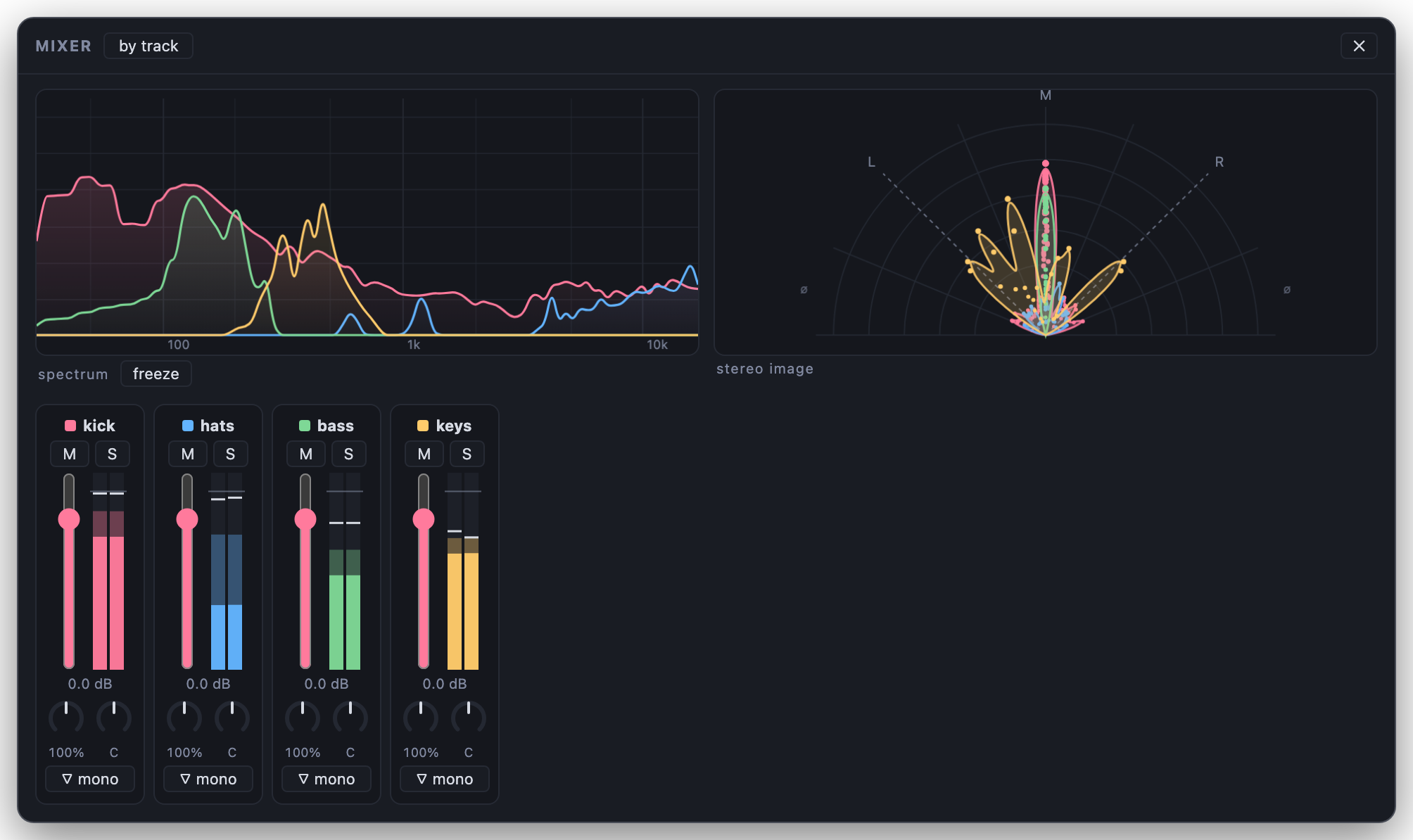
{app+g} opens a strip per track (meter, fader, pan, width, mute, solo, and
▽ mono for bass mono) beside a spectrum and a stereo image. Anything in the outer
ø wedges is lost in mono.
The mixer writes code. A fader rewrites the track's .postgain(),
mute and solo write _ and S, and clicking a strip's name renames the
track everywhere. The mix lives in the song.
Groups show as one strip that unfolds. The plots analyze up to eight strips, then only the master; folding groups keeps a big song under that.